
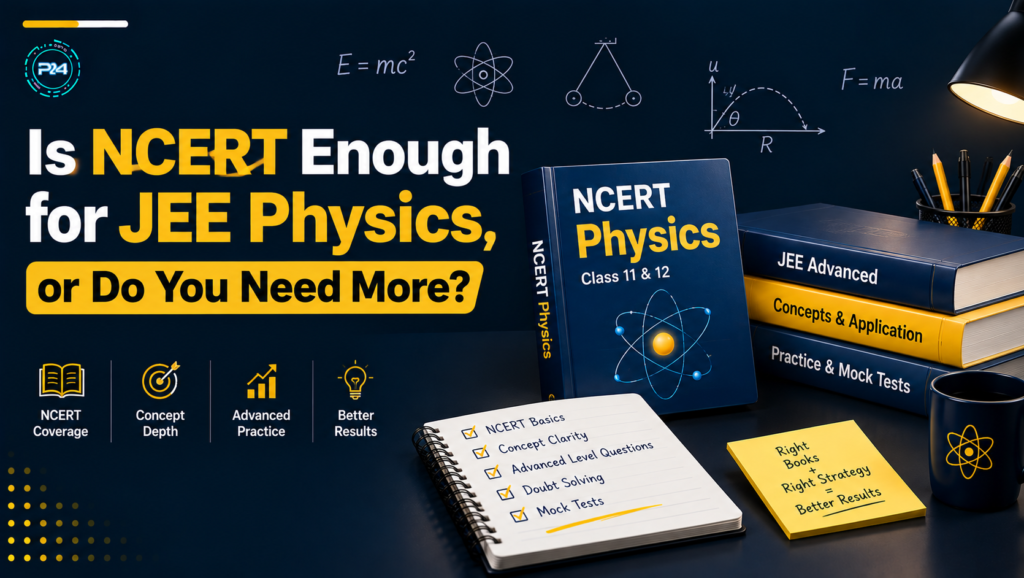
Is NCERT enough for JEE physics? The honest answer sits between yes and no. NCERT builds the base every JEE physics question stands on. It does not build the number of problems or the layered thinking that the exam demands.
Skip NCERT and formulas float with no foundation. Stop at NCERT, and the same formulas stay untested against real exam problems. Both mistakes cost marks. This guide separates what NCERT does well from what it leaves for you to add.
What NCERT Actually Gives You
NCERT is not a side book. The JEE Main syllabus is officially built on the NCERT Class 11 and 12 curriculum, and coaching material across the country still opens each chapter with it.
Read a chapter twice, and something changes. The first read explains a law. The second read explains why the law holds. That second layer is what most students skip, and it is the layer JEE actually tests.
NCERT covers three things well:
- Core theory, definitions, and derivations for every JEE physics chapter
- The logic behind each formula, not just the formula itself
- A base of application-based understanding, which is what conceptual JEE questions require
Skip that base and later problem sets feel like memorized tricks. Build it first and the same problem sets feel like applied logic.
Where NCERT Falls Short for JEE Physics
Depth is not the gap. Volume is.
NCERT physics books do not carry enough numerical problems for exam-level practice. One chapter may hold fifteen problems. A JEE aspirant needs that in the hundreds, across difficulty levels, before pattern recognition kicks in.
Multi-concept framing is the second gap. JEE frequently blends several topics into one question, and NCERT rarely does. A rotation problem in NCERT tests rotation. A rotation problem in JEE Main can test rotation, energy conservation, and friction in the same ten lines.
Picture a block sliding down a rough incline, then rolling. NCERT gives you the incline formula. JEE gives you the incline, the rolling condition, and a hidden friction twist, all in one question. Freeze there and marks slip away.
JEE Advanced widens this gap further. NCERT is a good foundation, but questions in exams like JEE Advanced are often multi-concept and framed to test problem-solving skills, not recall. A student who stops at NCERT for Advanced prep is bringing base-level tools to an advanced-level problem.
NCERT for JEE Main vs JEE Advanced Physics
Same book. Different mileage.
For JEE Main, NCERT plus previous year questions and a focused problem set gets most students to a strong percentile. For students aiming past 90 percentile, NCERT alone stops being sufficient somewhere around the applied numerical questions.
For JEE Advanced, the gap is wider from day one. Advanced physics leans on layered, unfamiliar problems, and NCERT was never built for that kind of test. Treat NCERT as the first step in Advanced prep, never the last.
| JEE Main | JEE Advanced | |
| NCERT role | Strong base, close to sufficient for a solid score | Base only, insufficient alone |
| What’s missing | Volume of practice problems | Volume plus multi-concept depth |
| What to add | HC Verma, chapter tests, PYQs | HC Verma, Irodov-level problems, Advanced PYQs |
What to Add Alongside NCERT
Depth first, then breadth, then speed. That order rarely fails.
Read the NCERT chapter. Then move to a reference book. HC Verma’s Concepts of Physics and Fundamentals of Physics by Halliday, Resnick, and Walker are named consistently by past JEE candidates for exactly this stage. They keep the same logic NCERT taught you, only stretched across harder situations.
A working loop looks like this:
- Read the NCERT chapter fully, twice, before touching a problem set
- Solve every NCERT in-text and exercise question without skipping any
- Move to HC Verma or Halliday-Resnick for that same chapter
- Take a timed chapter test within a week of finishing it
- Solve previous year questions from that chapter, Main and Advanced separately for droppers
Textbooks alone never write themselves into memory. Testing does that.
The Three-Bucket Fix for NCERT Gaps
After every test, sort every wrong answer into one bucket.
Bucket 1 — Conceptual error. The NCERT explanation itself was not internalized. Go back to that exact chapter, reread the derivation, and rewrite it from memory before moving on.
Bucket 2 — Application error. The concept is clear, but a multi-concept twist broke the approach. This is the exact gap NCERT leaves. Fix it with more problems of that specific pattern, not more NCERT reading.
Bucket 3 — Careless error. The concept and application were both fine. Slow down and recheck units, signs, and given conditions.
Most students treat every wrong answer as “study more.” That habit hides which bucket the gap is really in, and NCERT gets blamed for problems it was never built to solve.
So, Is NCERT Enough for JEE Physics?
Not alone, and not never. NCERT is the floor, not the ceiling.
Build every concept from NCERT first. Then stretch that concept with a reference book and chapter-wise testing. Skip the first step and formulas stay shallow. Skip the second and formulas stay untested against real exam pressure.
Physics24 builds this exact sequence into personal coaching. Pramod Niranjan sir holds a B.Tech from IIT Kharagpur and cleared IIT JEE 2007 with AIR 2849. He has mentored JEE aspirants for over 14 years, including at Resonance and Allen. Batches cap at two students, and every chapter test gets a personal, bucket-wise review.
Explore the Class 11 Foundation Batch, the Class 12 Target Batch, the JEE Dropper Batch, or the 1 to 1 Mentorship Program. Watch free lessons on the Physics24 YouTube channel. Then book a free demo class.
Is NCERT enough for JEE Main physics?
It builds a strong base and can carry a student to a solid percentile. For 90-plus percentile, add HC Verma and chapter-wise testing.
Is NCERT enough for JEE Advanced physics?
No. Advanced questions are multi-concept and unfamiliar in structure. NCERT starts the process but cannot finish it alone.
Which reference book should follow NCERT for physics?
HC Verma’s Concepts of Physics is the most recommended next step, followed by Halliday, Resnick, and Walker for droppers targeting Advanced.
Should I skip NCERT and go straight to reference books?
No. Skipping NCERT weakens the base every later problem depends on. Read NCERT first, then stretch with harder material.