1-to-2 classes are a focused learning format where one teacher teaches two students at a time. This allows interactive learning, healthy discussion, and a balanced teaching pace while still maintaining personal attention for each student.
In the current scenario, the teacher–student ratio in most coaching institutes is around 1:100, and in some large batches it can even reach 1:500. In such crowded classrooms, individual attention becomes almost impossible.
With 1-to-2 classes, the batch size is limited to only two students, which allows the teacher to closely monitor each student’s progress. Doubts are addressed properly, concepts are explained in depth, and the pace of teaching is balanced to suit both students.
This focused learning environment improves understanding, builds confidence, and significantly enhances performance in competitive exams like JEE Main, JEE Advanced, or NEET.

Students get tailored guidance according to their current level while learning in a small group of two. The teaching speed is balanced and adjusted as per the requirements of both students. Homework and study material can be modified based on the needs of the students.
Students receive focused attention, regular feedback, tests, and peer interaction, ensuring overall development of subject knowledge along with healthy discussion and collaborative learning.
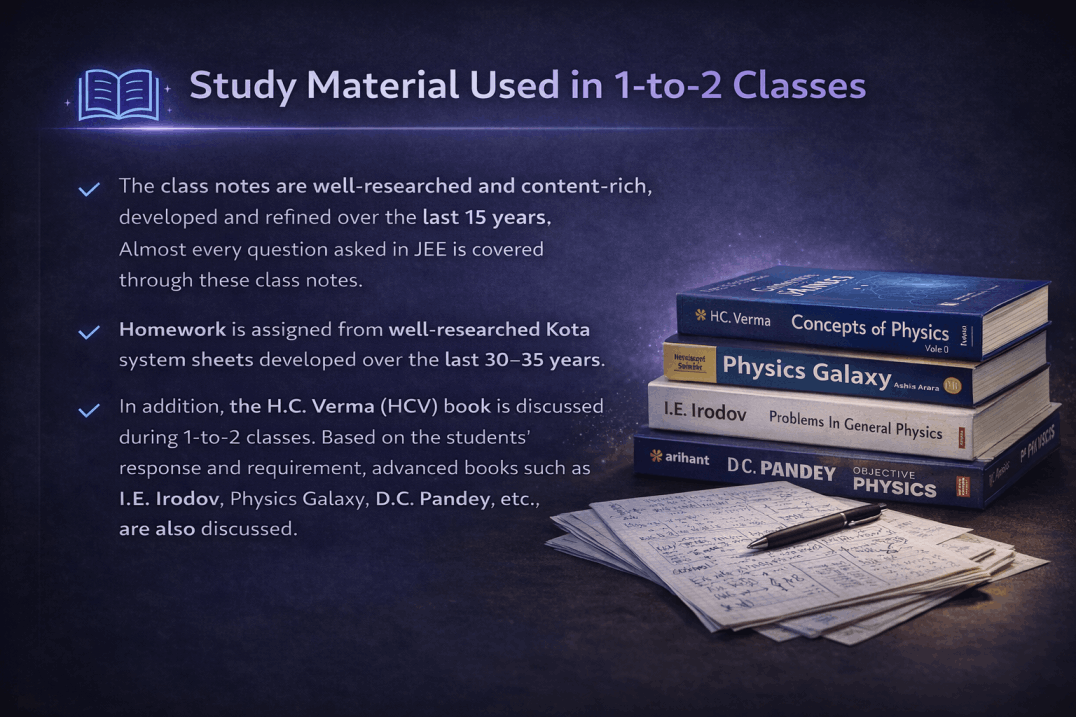
The class notes are well-researched and content-rich, developed and refined over the last 15 years. Almost every question asked in JEE is covered through these class notes.
Homework is assigned from well-researched Kota system sheets developed over the last 30–35 years. In addition, the H.C. Verma (HCV) book is discussed during 1-to-2 classes. Based on the students’ response and requirement, advanced books such as I.E. Irodov, Physics Galaxy, D.C. Pandey, etc., are also discussed.
Test Frequency
One test is conducted immediately after the completion of each chapter. The test discussion is done during the class itself. In addition, periodic part-syllabus tests and full-syllabus tests are conducted to ensure proper understanding and reinforcement of concepts.
Based on the student’s response during the class, Daily Practice Problems (DPPs) are provided. Each DPP consists of 10–20 questions from mixed topics (till taught).
This approach ensures that the previously taught topics remain fresh in the student’s mind and the subject stays continuously revised.