If you’ve started asking around for 1-on-1 physics tuition for JEE, you’ve probably noticed something frustrating: no two quotes look alike. One tutor quotes a flat monthly fee, another quotes per hour, a third wants a lump sum for the full syllabus. There’s no published “market rate” you can compare against, which makes it hard to know if a number is fair or inflated.
This post breaks down what actually drives 1-on-1 physics tuition fees for JEE, so you can evaluate a quote intelligently instead of guessing.
Why 1-on-1 Physics Costs More Than a Batch Course
In a typical large coaching institute, one teacher may be handling anywhere from 100 to 500 students in a batch. The teacher-student ratio problem is exactly why so many capable students underperform, not from lack of effort, but from lack of individual attention. In a batch, the pace is fixed, doubts queue up, and a student’s specific weak areas rarely get addressed.
1-on-1 tuition flips this. The teacher’s time is entirely allocated to one student (or, in a 2-to-1 format, split between just two). That’s a fundamentally different service, and the fee reflects the fact that a mentor can only take on a small number of 1-on-1 students at a time; attention doesn’t scale the way batch seats do.
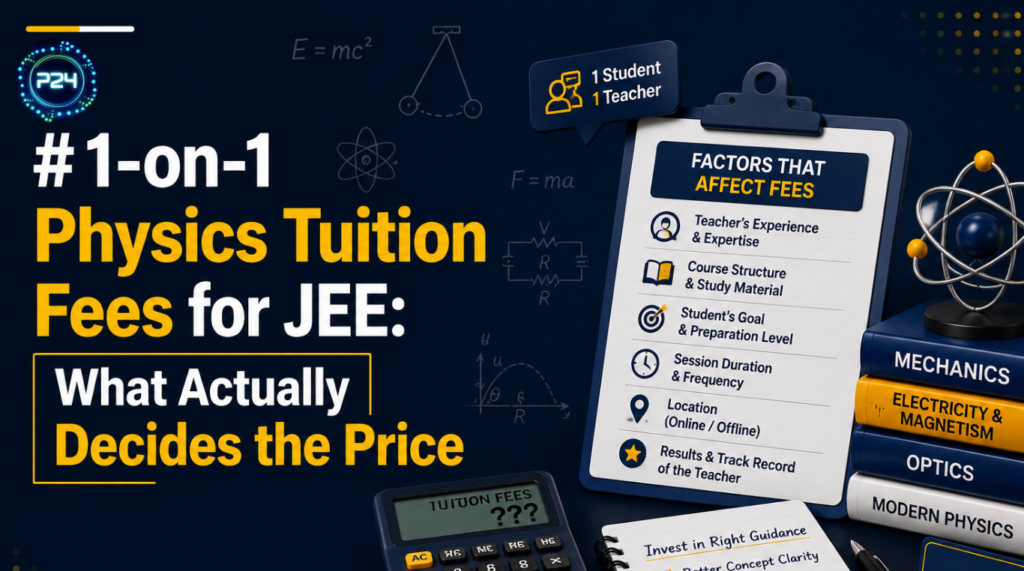
The Main Factors That Decide the Fee
Mentor’s background and experience: A mentor who is an IIT graduate with over a decade of JEE-specific teaching experience, including time at recognized institutes, commands a different fee than a generalist tutor. Experience directly affects how efficiently doubts get resolved and how well problem-solving strategy is taught for JEE Advanced-level questions.
1-to-1 vs 2-to-1 format: A pure 1-to-1 class costs more than a 2-to-1 class, where two students share the batch and, therefore, the fee. 2-to-1 still keeps the batch small enough for individual doubt-solving, but at a lower per-student cost.
Class level: Foundation, Target, or Dropper: Fee structures usually differ across the Class 11-Foundation Batch, Class 12-Target Batch, and Class 13-Dropper Batch. Dropper-batch tuition tends to be priced for intensity full syllabus, faster pace, more testing, while Class 11 foundation courses are paced over a longer runway.
Course duration and scope: Whether you’re enrolling for one chapter, one academic year, or a full 2-year JEE preparation cycle changes the total fee, even if the per-month cost looks similar.
What’s included beyond live classes: Recorded lectures, homework sets, Daily Practice Problems (DPPs), chapter tests, and doubt-clearing sessions are either bundled into the tuition fee or charged separately depending on the tutor. Always confirm what’s inside the quoted number.
1-on-1 Physics Tuition Fees for JEE
| Class Format | Fee |
| 1-to-1 Online Classes | ₹4,000 per hour |
| 2-to-1 Online Classes | ₹2,500 per hour per student |
1-to-1 Online Classes
Students who require all-out personal attention, flexible pacing and individualized instruction, personalized homework, regular testing, and individual tracking.
2-to-1 Online Classes
For students who would prefer a more focused learning environment with a small group in which there is a lot of interactive discussion, immediate feedback, attention, and sharing with 1 other student in the class.
What a JEE Physics Tuition Fee Should Actually Include
Before comparing prices, compare what’s included. A good 1:1 teaching program should include:
- In addition to the practical skills, students are taught the concepts.Students are also taught concepts – not problems just dumped on them.
- Homework closely matching the work covered in the lesson.
- Daily Practice Problems for continuous revision
- Chapter-end tests and immediate discussion of them.
- Doubt-clearing integrated into each lesson, not an additional charge.
- Considering a demo class before signing up, to get a feel for how things work out with that teacher
If a quote is lower than usual, note that it may be excluding tests, DPPs, or doubt sessions; the prices may be cut there.
Is 1-on-1 Physics Tuition Worth the Fee?
In Physics, a subject in which the problems in JEE Advanced test not only the ability to recall but also concepts and the ability to give a single thought to the problem, there is a definite payoff in focus. Institutes with 1:100 or 1:500 batch sizes cannot provide a student with repeated correction and a pacing adjustment as 1-on-1 would provide.
The honest answer to “worth it” doesn’t just boil down to the price; it is about the price vs attention received. If a student in a 200-student batch course does not finish the course without requiring a second round of preparation, because the concepts were not set in their mind, then a batch course is not any cheaper in real terms than a 1-on-1 course with a higher ‘sticker price.
How to Get an Accurate 1-on-1 Fee Quote
Because 1-on-1 pricing depends on class level, format, and duration, the only reliable way to get an accurate number is to discuss your specific situation. You can check the 1 to 1 Mentorship Program page for program details, or reach out directly through the Contact page for a demo class and a fee structure tailored to your class level and goals. You can also read more preparation-focused articles on the Physics24 Blog.
How much does 1-on-1 physics tuition for JEE cost per month?
It varies based on class level, format (1 to 1 vs 2 to 1), and length of course. These factors can result in quite a difference, so it’s better to receive a custom quote after a demo class than a generic one.
Is 1-on-1 physics tuition more expensive than joining a large batch?
Yes, 1-on-1 tuition will normally be more expensive than a large batch course, since the teacher is not divided among 100+ students. The downside is that doubts will be resolved more quickly, and the speed will follow the student’s pace, and concepts will be better retained.
What's the difference between 1-to-1 and 2-to-1 tuition fees?
The classes are typically 2-to-1, which divides the mentor’s time—and cost—in half, though still small enough to give personalized attention
Does the tuition fee include tests and Daily Practice Problems (DPPs)?
This would depend on the tutor/institute. Chapter tests and DPPs are part of a programme and should be included in the core fee, not an extra, as it is possible that excluding extras could make an “off-the-shelf” programme more expensive than a well-structured programme.
Can I take a demo class before paying for 1-on-1 physics tuition?
Before enrolling in a 1 on 1 program, most credible programs will provide an introductory class for you to try out and determine the best fit and teaching style. This is important to stress, no matter which candidates you’re looking at.