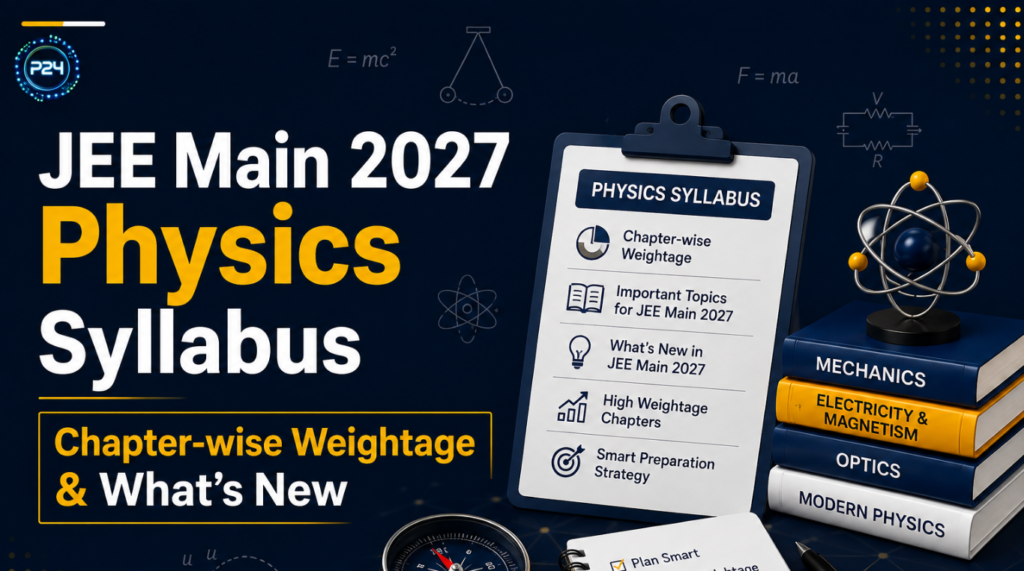
If you are preparing for JEE Main 2027, the first thing you need is absolute clarity on one thing.
What does the Physics syllabus look like? Which chapters carry maximum weightage? Where should you spend maximum preparation time? And what has changed from previous years?
This complete guide answers all of these questions based on the latest NTA syllabus and five-year previous paper trend analysis.
Physics24 has helped students crack JEE Main and JEE Advanced with consistent results. This guide is built on the same strategic understanding that Pramod Niranjan sir, an IIT Kharagpur graduate and 14-year Kota teaching veteran, uses when planning preparation for every student.
JEE Main 2027 Physics Exam Pattern Overview
For any weightage question, be it chapter-wise or otherwise, be aware of the exam structure.
There are a total of 25 questions in the Physics section of JEE Main for a total of 100 marks. Consists of 20 MCQs and 5 numerical value questions.
The JEE Main pattern was 75 questions in total, 25 in each subject Physics, Chemistry, and Maths and the total marks for the paper were 300, with +4 marks for every correct answer and -1 mark for each wrong answer.
Note: Numerical value questions have no penalty for incorrect answers. This is why they are top-priority attempt questions. If you don’t know the answer to a numerical question, even if there is a chance of getting it wrong, it is still better to do a calculation and mark it than to leave the question blank.
What’s New in JEE Main 2027 Physics Syllabus
JEE Main 2027 syllabus is likely to be the same as JEE Main 2026. As of March 2026, NTA has not announced any changes.
The NTA does not anticipate any significant changes from 2024 for 2027. Some topics have been removed from previous versions in the 2024 revision. Before taking any final decision, check the official notification of the NTA regarding the syllabus, as the NTA might subject it to modifications without prior notification.
Important trend to note:
Since 2022, the JEE Main Physics paper has witnessed an increase in multi-concept questions, which are problems that involve two or more chapters. This has been observed especially when answering questions in Mechanics with Thermodynamics and Electrostatics with Magnetic Effects. The inclusion of Experimental Skills questions has also increased, and these have become an area of no longer be ignored.
This trend directly affects preparation strategy. Single chapter preparation is no longer sufficient. Cross-chapter problem solving must be built into your daily practice from early preparation.
JEE Main 2027 Physics Complete Chapter-wise Weightage
NTA does not officially release chapter-wise weightage for JEE Main 2027. All available chapter-wise weightage data is prepared using trend-based analysis of previous year question papers.
Based on five-year previous paper analysis, here is the complete chapter-wise priority breakdown:
🔴 High Priority Chapters Appear in Almost Every Paper
Topics such as Ray Optics, Units and Measurements, Electrostatics, Current Electricity, and core Mechanics chapters continue to appear frequently across sessions.
| Chapter | Approx Weightage | Questions Expected |
| Mechanics (Laws of Motion, WEP, Rotational) | 24 to 30% | 6 to 8 |
| Electrostatics and Capacitors | 8 to 10% | 2 to 3 |
| Current Electricity | 8 to 10% | 2 to 3 |
| Ray Optics | 6 to 8% | 1 to 2 |
| Modern Physics | 8 to 10% | 2 to 3 |
| Electromagnetic Induction | 6 to 8% | 1 to 2 |
Mechanics alone accounts for nearly 25 to 30 percent of the Physics section.
🟡 Medium Priority Chapters Appear Most Years
| Chapter | Approx Weightage | Questions Expected |
| Thermodynamics | 4 to 6% | 1 to 2 |
| Magnetic Effects of Current | 4 to 6% | 1 to 2 |
| Wave Optics | 4 to 6% | 1 to 2 |
| Alternating Current | 4 to 6% | 1 to 2 |
| Simple Harmonic Motion | 4 to 6% | 1 to 2 |
| Waves and Sound | 3 to 4% | 1 |
| Experimental Skills | 4 to 6% | 1 to 2 |
🟢 Low Priority Chapters Appear Occasionally
| Chapter | Approx Weightage | Questions Expected |
| Units and Dimensions | 2 to 4% | 1 |
| Kinematics | 2 to 3% | 1 |
| Gravitation | 2 to 3% | 1 |
| Properties of Matter | 2 to 3% | 1 |
| Electromagnetic Waves | 2 to 3% | 1 |
| Semiconductor Devices | 2 to 3% | 1 |
The Big 4 Units That Dominate JEE Main 2027 Physics
Mechanics plus Electrodynamics plus Optics plus Modern Physics equals approximately 75 percent of the paper. Master these four units first.
This is the single most important strategic insight for JEE Main 2027 Physics preparation.
Unit 1: Mechanics (25 to 30%)
This is the backbone of JEE Main Physics. Laws of Motion, Work Energy Power, Rotational Motion, Gravitation and Properties of Matter all fall under Mechanics. Finish Newton’s Laws and Rotational Motion first. These chapters form the conceptual foundation for everything that follows.
Unit 2: Electrodynamics (20 to 25%)
Electrostatics, Current Electricity, Magnetic Effects, Electromagnetic Induction, and Alternating Current together form this unit. Electrodynamics, including Electrostatics, Current Electricity, Magnetism and EMI, plus Modern Physics can account for a large share of questions and are relatively formula- and concept-driven, making them high return.
Unit 3: Optics (8 to 10%)
Ray Optics is consistently one of the most frequently tested chapters. Optics questions are mostly formula-based. Keep a short formula list on your desk for quick revision. Wave Optics appears less frequently but carries decent weightage.
Unit 4: Modern Physics (8 to 10%)
Photoelectric Effect, Atomic Models, Nuclear Physics and Semiconductor Devices. Modern Physics is one of the JEE Main 2027 high-weightage chapters, and it is less calculation-heavy. Do not push it to the last week.
How to Use Chapter-wise Weightage in Your Preparation
The weightage trap to avoid: Some students skip low-weightage chapters entirely to save time. This is risky. JEE Main can pull a question from anywhere. A skipped easy chapter is a guaranteed loss. Weightage tells you where to go deep and where to prioritize, not what to abandon.
Here is the right way to use this weightage data:
60% of study time: High priority chapters. Deep concept building. Irodov-level practice for JEE Advanced preparation. DPP practice daily.
30% of study time: Medium priority chapters. Thorough concept coverage. Standard DPP practice. Previous year question solving.
10% of study time: Low priority chapters. NCERT reading. Basic formula understanding. Quick revision before exam.
Never skip foundational low-weightage topics if high-weightage chapters depend on them. Kinematics and Newton’s Laws may yield only 1 to 2 direct questions each, but mastering them is mandatory before tackling Rotational Motion, Work-Energy, or Electrostatics.
Experimental Skills The Hidden Scoring Opportunity
Many students completely ignore Experimental Skills in JEE Main preparation. This is a costly mistake.
Experimental Skills covers 18 standard laboratory experiments. It is one of the easiest and most predictable sections, typically contributing 1 to 2 direct questions in every JEE Main paper.
These questions are straightforward. They are predictable. And most students leave them unprepared. Covering Experimental Skills thoroughly in 3 to 4 days of focused study can guarantee 4 to 8 marks in every JEE Main attempt. Never skip this section.
Chapter-wise Preparation Strategy for JEE Main 2027 Physics
Month 1 to 2: Mechanics Foundation
Cover all Mechanics chapters thoroughly. Laws of Motion first. Then Work Energy Power. Then Rotational Motion. Daily DPP practice after every class. Chapter test after every topic.
Month 3 to 4: Electrodynamics
Electrostatics, Current Electricity, Magnetic Effects, Electromagnetic Induction, and Alternating Current. These chapters are interconnected. Build them in sequence. Do not jump between them randomly.
Month 5: Optics and Modern Physics
Ray Optics, Wave Optics, Modern Physics, and Semiconductor Devices. These chapters are relatively compact. Cover them with a formula-focused approach. Solve previous year questions chapter-wise.
Month 6: Thermodynamics, SHM, Waves
Complete remaining medium priority chapters. Begin full syllabus revision. Start full syllabus mock tests.
Month 7 onwards: Mock Tests and Gap Filling
Attempt a minimum of 8 to 10 full syllabus JEE Main mock tests. Analyze every test individually. Fix specific weak areas identified from each test.
How Physics24 Prepares Students Chapter-by-Chapter for JEE Main 2027
Physics24 follows this exact chapter priority system in every batch.
Physics24 is founded and taught by Pramod Niranjan. B.Tech from IIT Kharagpur. AIR 2849 in IIT JEE 2007. 14 years at Resonance and Allen in Kota. Maximum 2 students per batch.
Every student at Physics24 gets a personalized chapter-wise preparation plan built around this weightage data combined with their individual weak area analysis. High weightage chapters receive maximum depth and DPP practice. H.C. Verma Concepts of Physics is covered thoroughly for concept building. I.E. Irodov Problems in General Physics is covered for JEE Advanced depth.
Chapter tests after every topic. Full syllabus mock tests from month four. Individual performance tracking after every single test.
Courses available at Physics24:
- The Class 11 Foundation Batch covers the complete JEE Main 2027 Physics syllabus from Class 11 foundation.
- The Class 12 Target Batch covers board exams alongside complete JEE Main 2027 preparation.
- The JEE Dropper Batch gives drop-year students the most targeted chapter-wise preparation available.
- The 1 to 1 Mentorship Program offers completely personalized chapter-wise coaching based on individual student needs.
Watch free JEE Main 2027 Physics chapter lectures on the Physics24 YouTube channel.
Student Results at Physics24
Students at Physics24 have secured admissions into IIT Bombay, IIT Delhi, IIT Kanpur, IIT Roorkee and IIT Dhanbad. One student scored a perfect 100 out of 100 in Physics in JEE Main.
How to Join Physics24
- Visit physics24.in and explore all courses
- Book a free demo class with Pramod sir
- Get a personalized JEE Main 2027 chapter-wise preparation plan
- Enrol and begin your focused, structured JEE Physics preparation
You can also reach out directly:
- +91 7711995520
- pramod.iitkgp07@gmail.com
- Download the Physics24 App on Google Play
- Read more JEE tips on the Physics24 blog
Final Thoughts
JEE Main 2027 Physics rewards strategic preparation. Understanding chapter-wise weightage helps you allocate your time effectively. High priority chapters deserve maximum depth. Medium priority chapters need thorough coverage. Low priority chapters need at least basic understanding.
The big four units Mechanics, Electrodynamics, Optics, and Modern Physics together account for approximately 75 percent of the paper. Master these first. Then strengthen medium priority chapters. Never completely skip any chapter.
Physics24 prepares every student with this exact chapter-priority system. Personalized chapter-wise plan. Kota-level DPP practice. Maximum 2 students per batch. Immediate doubt resolution. Individual performance tracking.
Book your free demo class today at physics24.in and begin your JEE Main 2027 Physics preparation with the right chapter-wise strategy from day one.
What is the JEE Main 2027 Physics syllabus?
The Physics Syllabus for JEE Main 2027 consists of 29 chapters from NCERT Physics textbooks of Class 11 and Class 12. It covers topics like Mechanics, Electrodynamics, Optics, Modern Physics, and Experimental Skills. Mechanics and Electrodynamics together have the highest weightage, which is about 35 to 40 per cent.
Which chapters have the highest weightage in JEE Main 2027 Physics?
The highest weightage for Physics in JEE Main 2027 for most of the students is expected to be on Mechanics, Electrostatics, Current Electricity, and Modern Physics. The chapters can contribute a significant amount to the Physics section as a whole. Get a custom-made chapter-wise preparation plan from Contact Physics24.
Has the JEE Main 2027 Physics syllabus changed from 2026?
As of March 2026, NTA has not yet released any updates regarding any changes in the syllabus for JEE Main 2027. The syllabus continues to be the same as 2026. Always check the official NTA notification before taking your preparation plan for granted, however. As per the official website of JEE Main, the only authority that makes all updates to the syllabus is NTA.
How many questions come from Mechanics in JEE Main 2027 Physics?
Mechanics is likely to have around 6-8 questions in JEE Main Physics 2027. It can be assumed that it might carry around 24-30% weightage in the approximate chapters. This is because Mechanics is the most important unit in JEE Main Physics. Read about how Physics24 teaches Mechanics.
Should I skip low-weightage chapters in JEE Main 2027 Physics?
No. Don’t miss out on any chapter in JEE Main 2027 Physics. It is suggested to go through the complete syllabus of JEE Main along with giving special attention to the topics with high weightage. Even for low-weightage chapters, there are questions appearing in JEE Main, and one wrong effort on a very easy question may impact the percentile drastically. View a free sample class at Physics24 here.