
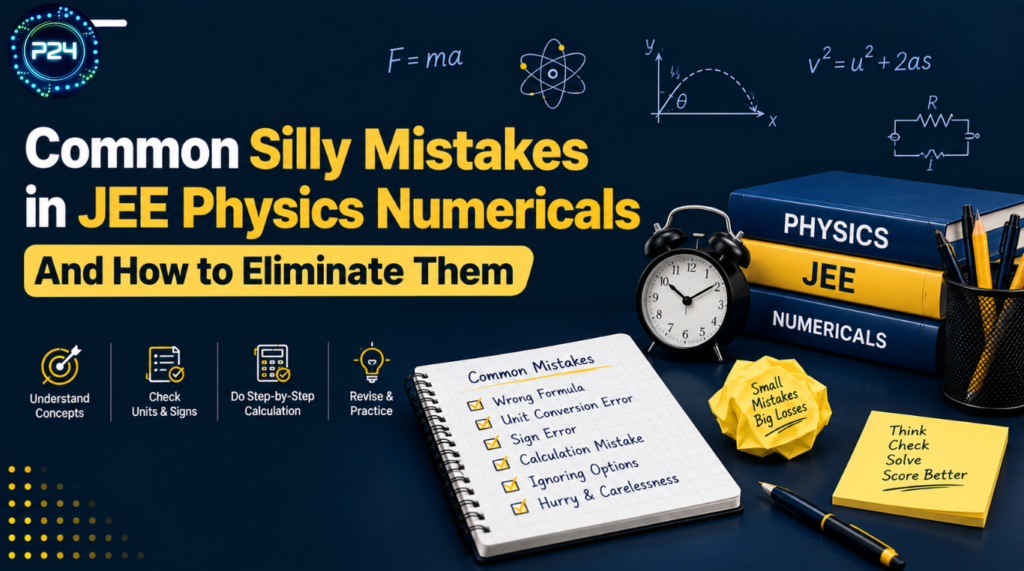
Silly mistakes in JEE physics numericals are not random. They repeat, shift by shift, year by year. Ask any student after a JEE Main session and one line comes back the same way. The paper was easy, but silly mistakes ate the score.
That is not a feeling. It is a pattern. In competitive sessions, small mistakes create a big swing in percentile and rank. This guide names the repeat offenders and gives a fix for each one.
Why Silly Mistakes in JEE Physics Numericals Keep Repeating
A silly mistake feels random at the moment. It never is.
Most silly mistakes are process failures, not knowledge failures. The concept was right. The setup skipped a step. No error log, no rigid method, no way to spot the same mistake before it repeats in the next test.
None of these mistakes point to low ability. They point to a missing system. That system is what this guide builds.
Mistake 1 — Misreading the Question
The concept is right. The answer is wrong anyway. That combination is the most painful kind of silly mistake, because full marks were within reach and slipped away on a word.
Statement-based numericals hide small qualifiers. “Maximum,” “just,” “minimum,” “at rest,” and “released from rest” each change the setup completely. A block “just” completes a circular loop needs a different equation than a block moving at constant speed through it.
Fix: pause for three seconds on every number before writing a single line. Underline or mentally mark the qualifier words first. Reading a question fast is not the same as reading it once.
Mistake 2 — Sign Errors
Sign errors are the single most common source of lost marks in mechanics and optics numericals.
They creep in through incomplete coordinate setup. A student writes the equation of motion, then assigns direction halfway through, and the two disagree. Mirror and lens formulas are common victims. The mirror formula uses 1/v + 1/u. The lens formula uses 1/v – 1/u. Confuse the two, and the final image position flips.
Fix: define the coordinate system and the sign convention for u and v, before writing any equation. Draw a rough ray diagram even when the question does not ask for one. It works as a sanity check against the numerical answer.
Mistake 3 — Unit and Significant Figure Slips
Formulas without units are half-finished formulas. Many aspirants solve physics problems correctly but ignore the units carried through each step, and the answer comes out dimensionally wrong or off by a large factor.
Modern physics numericals are the worst offenders. Mixing electron-volts and joules changes an answer by a factor of roughly 10¹⁹. Using g = 10 instead of the value the question specifies, without checking whether that approximation is allowed, quietly shifts the result too.
Significant figures cause a second, smaller bleed. Giving too many or too few significant digits, or ignoring percentage error in experiment-based numericals, costs marks in a well-solved question.
Fix: write units at every intermediate step, not only in the final line. Check which g value, and how many significant figures, the question specifies before rounding.
Mistake 4 — Skipping the Diagram
Numericals in rotation, optics, and circuits punish students who solve directly from the formula without drawing the situation first.
Not drawing a proper diagram is one of the most common and preventable mistakes in JEE physics. A rolling-without-slipping problem, or a combination of two lenses, is far easier to set up correctly on paper than in the head.
Fix: draw first, even for a “simple” numerical. A ray diagram or a free-body diagram takes fifteen seconds and prevents a five-minute wrong turn.
Mistake 5 — No Fixed Problem-Solving Order
Randomness is where silly mistakes live. A rigid order removes it.
A dependable sequence looks like this every time: free body diagram, then the governing law, then algebra, then units, then the final check. Skip a step under time pressure, and the skipped step is exactly where the error hides.
Fix: use the same four-step order on every numerical, in practice and in the exam. Consistency, not speed, is what prevents silly mistakes under pressure.
Mistake 6 — Guessing Instead of Verifying
In JEE Advanced and negative-marking sections of Main, a guess that “seems close” to the calculated value is a common trap. Do not guess or mark whichever option looks nearest to your working; that habit alone accounts for a chunk of avoidable negative marking.
Fix: solve the numerical completely on paper before matching it to an option. Match against your own number, never against your gut sense of which option looks right.
The Error Log Turning Mistakes Into a System
Naming a mistake once changes nothing. Naming it every week, in writing, changes the score.
Maintain a running error log. Keep track of your specific mistakes to spot which one repeats. After every test:
- Write down the exact question and the exact wrong step
- Tag it as misreading, sign error, unit error, missed diagram, or no-order error
- Solve the same numerical again from scratch, using the four-step order
- Revisit the log for ten minutes before every future mock, not after it
A log with the same tag appearing three times is not bad luck. It is a habit that has not been fixed yet.
How Physics24 Builds This Into Coaching
At Physics24, every wrong answer is not just marked. It is sorted.
Pramod Niranjan sir holds a B.Tech from IIT Kharagpur and cleared IIT JEE 2007 with AIR 2849. He has mentored JEE aspirants for over 14 years, including at Resonance and Allen. Batches cap at two students, so every silly mistake gets flagged and tracked personally, test after test, instead of being lumped into a generic “revise more” note.
Class 11 Foundation Batch
Class 12 Target Batch
JEE Dropper Batch
1 to 1 Mentorship Program
Physics24 YouTube channel
book a free demo class.
What are the most common silly mistakes in JEE physics numericals?
Misreading qualifier words, sign errors, unit and significant figure slips, skipped diagrams, no fixed solving order, and guessing instead of verifying.
Can silly mistakes really cost 20 to 30 marks?
Yes. Across a full paper, several small errors compound, and that swing regularly changes percentile and rank in a close session.
How do I stop repeating the same silly mistake?
Keep an error log. Tag each wrong answer by mistake type and revisit the log before every mock. Patterns that repeat three times point to the real gap.
Does drawing a diagram really help avoid mistakes?
Yes. A rough free-body or ray diagram exposes sign and setup errors before they turn into a wrong final answer.