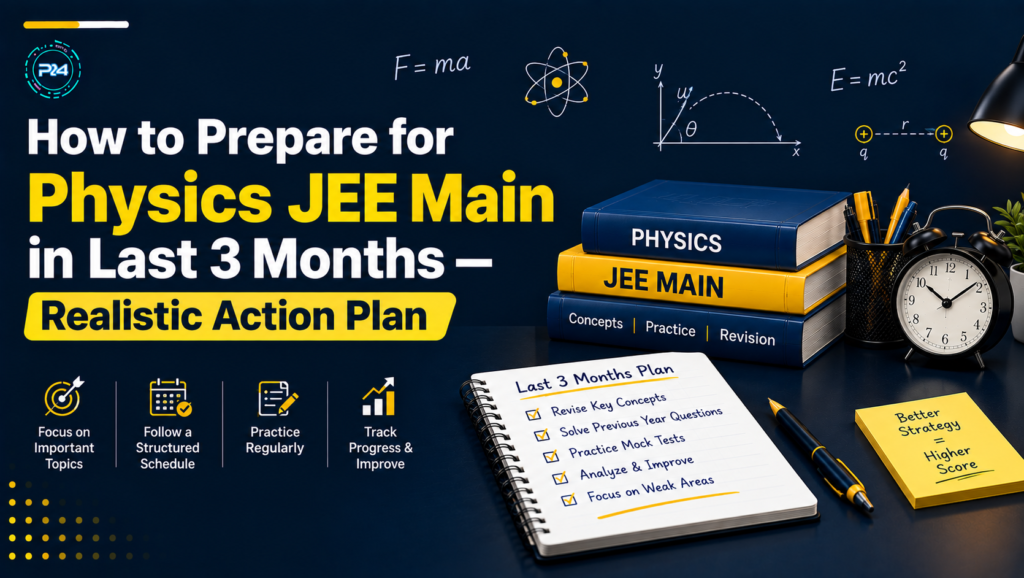
Three months feels short until it is broken into weeks. Most students waste the first month deciding where to start. That single delay is often the difference between a plan that works and one that collapses in week ten.
This guide is not a topper’s idealized routine. It is a realistic way to prepare for Physics JEE Main when the syllabus is large, time is fixed, and panic is not a strategy.
Why Most Last-Minute Physics Plans Fail
Two mistakes repeat every session. Students either start new chapters too late, or they revise everything equally instead of by weightage.
An efficient plan in limited time has to be smart and intensive, not just long. That means picking high-scoring topics first, not working front to back through the syllabus like it is month one of Class 11.
The second failure is silent. Passive reading feels like progress. It rarely converts into marks. Active recall and testing do the actual work.
Step 1: Know Exactly What You Are Testing Against
Before touching a single chapter, confirm three things: the current syllabus, the exam pattern, and your own weightage data. Skipping this step wastes weeks on low-return topics.
Recent JEE Main Physics papers show a clear pattern. Current Electricity, Electrostatics, and Magnetic Effects of Current have appeared most frequently in recent sessions. Prioritize accordingly, not by personal preference.
Confirm the pattern too. Physics carries 25 questions: 20 MCQs and 5 numerical-value questions, all five compulsory. Build every mock around that exact split.
Step 2: Rank Chapters by Weightage, Not by Comfort
Comfort chapters feel productive to revise. They rarely move the score. Weightage chapters do.
| Priority | Chapters | Why |
| High | Mechanics, Current Electricity, Electrostatics, Magnetic Effects | Together carry the largest share of recent papers |
| High | Modern Physics | Formula-driven, high return per hour invested |
| Medium | Optics, EMI and AC, Thermodynamics | Steady, predictable weightage |
| Low | Units and Measurements, EM Waves, Semiconductors | Small weightage, quick revision only |
Five units alone contribute roughly 55 to 60 percent of JEE Main Physics marks. Spend the first six weeks almost entirely there.
Step 3: The Realistic Three-Month Calendar
Three months is twelve to thirteen weeks. Split it into three phases, not one long blur.
Weeks 1 to 5: Concept Consolidation
Revise high-weightage chapters from mechanics, electrostatics, and current electricity first. Read the theory once, solve NCERT and HC Verma problems for that chapter, then take a timed chapter test the same week. Build a one-page formula note per chapter as you go. Do not start a new chapter without testing the last one.
Weeks 6 to 9: Section Tests and Weak-Area Repair
Begin full Physics section tests: 25 questions, 60 minutes, exact JEE Main format. Now the error log matters more than new content. Sort every wrong answer into a concept, application, or careless bucket, and fix each differently. Cover medium-priority chapters here, in the gaps between section tests.
Weeks 10 to 12: Full Mocks and Formula Recall
Full-length mocks now, all three subjects together, real NTA pattern. A minimum of 15 to 20 full-length mocks across the last three to four months is a reasonable target, so weigh most of them here. Revise formula sheets daily. Do not start any new topic in the final two weeks. Revision and speed, not new material, decide the last stretch.
Step 4: Daily Structure That Actually Holds
A plan with no daily shape collapses by week three. Time blocking fixes that. Assign fixed blocks to each subject, with one buffer day a week for backlog and one full day for a mock or sectional test.
A workable weekday split for Physics inside a three-subject day:
- One long block for chapter theory and problem-solving, ideally in the morning when focus is highest
- One short block, 20 to 30 minutes, for formula and short-note revision, done daily without exception
- One weekly slot for a section test, followed immediately by full error-log review
Set specific daily goals, not vague ones. “Solve 30 PYQs from Current Electricity” moves the score. “Study Physics today” does not.
Step 5: Testing Is the Actual Preparation
Reading a chapter twice is not the same as testing it once. A chapter test forces recall under time pressure, the exact condition of exam day.
Studying three hours, analyze three hours is a rough but useful rule. One full mock test every two to three days once the syllabus is largely complete keeps this loop alive through the last month.
After every test, sort mistakes honestly:
- Conceptual error — return to that specific theory, not the whole chapter
- Application error — solve more problems of that exact pattern
- Careless error — slow down, recheck units and signs before final answer
Skip this sorting, and the same mistake shows up in every mock until exam day.
Step 6: What to Do in the Final 30 Days
The final month is about smart work, not new work. Do not start new topics in this window. Revise high-weightage chapters, use flashcards for formula recall, and take mocks to check speed rather than to learn concepts.
Solve previous year questions from the last ten to twelve years in this stretch. Pattern recognition, at this stage, is worth more than another new problem set.
How Physics24 Builds This Plan Into Coaching
A calendar on paper only works with someone checking whether it is followed. At Physics24, Pramod Niranjan sir personally reviews test performance every week and adjusts the next week’s targets, rather than leaving students to guess at their own weak areas.
Pramod sir holds a B.Tech from IIT Kharagpur and cleared IIT JEE 2007 with AIR 2849. He has mentored JEE aspirants for over 14 years, including at Resonance and Allen. Batches cap at two students, so this three-month plan gets adjusted to the individual, not applied as a generic template.
Explore the Class 12 Target Batch, the JEE Dropper Batch, or the 1 to 1 Mentorship Program. Watch free lessons on the Physics24 YouTube channel. Then book a free demo class.
Is three months enough to prepare for Physics JEE Main?
Yes, if the plan is weightage-based and testing-heavy. It is not enough for a chapter-by-chapter, unranked approach.
Which chapters should I prioritize first?
Mechanics, Current Electricity, Electrostatics, Magnetic Effects, and Modern Physics carry the largest share of recent papers.
How many mock tests should I take in three months?
Aim for 15 to 20 full-length mocks, weighted toward the final month, alongside regular section tests earlier on.
Should I start new topics in the last 30 days?
No. Use the final month for revision, formula recall, and speed through previous year questions only.