Every JEE aspirant asks this question at some point.
What is the difference between JEE Main and JEE Advanced Physics?
Are they the same syllabus? Is JEE Advanced just harder questions? Do I need a completely different preparation strategy for each?
These are important questions. Understanding the differences between JEE Main and JEE Advanced Physics is essential for developing the right preparation strategy. Students who do not understand this difference often prepare for one exam while neglecting the other.
In this complete guide, we explain every important difference between JEE Main and JEE Advanced Physics. Syllabus differences. Difficulty differences. Question type differences. Preparation strategy differences. And how Physics24 prepares students effectively for both examinations simultaneously.
What is JEE Main Physics
JEE Main is conducted by NTA National Testing Agency. According to the JEE Main official website, JEE Main Physics consists of 25 questions carrying 100 marks. The exam tests standard Physics concepts from the Class 11 and Class 12 NCERT syllabus with application-based questions.
JEE Main Physics is the gateway exam. Clearing JEE Main with a good percentile qualifies students for JEE Advanced. It also directly determines admission to NITs, IIITs and other centrally funded technical institutions.
What is JEE Advanced Physics
JEE Advanced is conducted by the IITs on a rotational basis. According to the JEE Advanced official website, only the top 2.5 lakh students who clear JEE Main are eligible to appear for JEE Advanced.
JEE Advanced Physics tests a completely different level of understanding. It goes far beyond standard NCERT concepts. It tests multi-concept analytical thinking, experimental reasoning and first-principle problem solving at a depth that JEE Main never reaches.
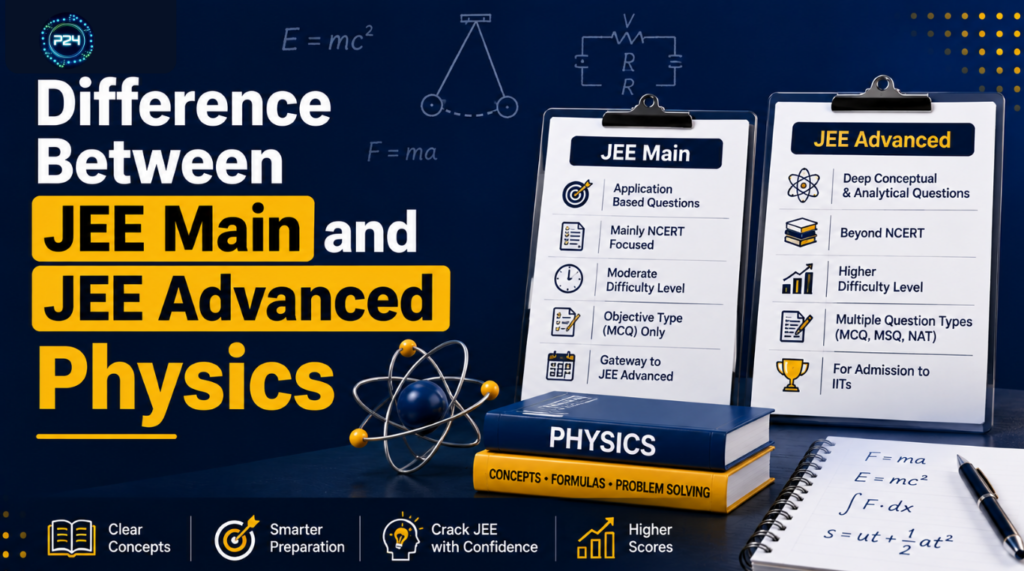
Key Differences Between JEE Main and JEE Advanced Physics
Difference 1: Difficulty Level
This is the most fundamental difference between JEE Main and JEE Advanced Physics.
JEE Main Physics Difficulty:
JEE Main Physics tests standard concepts at application level. Most problems require applying one concept with standard formulas. Questions follow predictable patterns. Good understanding of NCERT combined with regular DPP practice produces good JEE Main Physics scores.
JEE Advanced Physics Difficulty:
JEE Advanced Physics is significantly more difficult. Problems regularly combine two or three concepts from different chapters simultaneously. Questions test whether students genuinely understand the physical reasoning behind formulas. Many problems require multi-step analytical thinking that cannot be solved by formula application alone.
The jump from JEE Main difficulty to JEE Advanced difficulty is dramatic. Students who prepare only for JEE Main difficulty are consistently shocked by JEE Advanced Physics papers.
Difference 2: Syllabus Coverage
JEE Main Physics Syllabus:
JEE Main Physics syllabus is based closely on Class 11 and Class 12 NCERT. Every major chapter from both classes appears. The syllabus is broad but the depth required is moderate. NCERT-level understanding combined with application practice is sufficient for most JEE Main Physics questions.
JEE Advanced Physics Syllabus:
JEE Advanced Physics syllabus covers the same chapters but goes significantly deeper into each. Additionally, JEE Advanced includes topics that go beyond standard NCERT. Experimental physics, data-based reasoning and advanced applications of standard concepts all appear regularly in JEE Advanced.
The key insight is this. JEE Advanced syllabus is a deeper version of JEE Main syllabus. Not a completely different one. But the depth difference is enormous.
Difference 3: Question Types
JEE Main Physics Question Types:
- Single correct multiple choice questions most common
- Numerical value type questions: answer is an integer or decimal
- No multiple correct questions in JEE Main
JEE Advanced Physics Question Types:
- Single correct multiple choice questions
- Multiple correct multiple choice questions are most feared
- Integer type questions
- Match the column questions
- Paragraph-based question sets
- Linked comprehension type
Multiple correct questions in JEE Advanced are especially important. Partial marking applies. Getting some options correct and some wrong results in negative marking. This question type demands much higher precision and depth than JEE Main questions.
Difference 4: Marking Scheme
JEE Main Marking Scheme:
- Correct answer: +4 marks
- Wrong answer: -1 mark
- Unattempted: 0 marks
- Numerical type: +4 for correct, 0 for wrong (no negative)
JEE Advanced Marking Scheme:
- Single correct: +3, -1
- Multiple correct: Partial marks for partially correct answers. Negative marks for wrong selections.
- Integer type: +3, 0 (no negative)
- Match the column: varies by paper
The marking scheme difference between JEE Main and JEE Advanced Physics is significant. JEE Advanced’s multiple correct negative marking demands much higher accuracy and conceptual certainty before attempting any question.
Difference 5: Preparation Depth Required
JEE Main Physics Preparation:
NCERT reading plus H.C. Verma for concept building. Regular DPP practice at JEE Main difficulty. Previous year JEE Main papers. Chapter tests and full mock tests. This preparation level is sufficient for a good JEE Main Physics score.
JEE Advanced Physics Preparation:
H.C. Verma is just the starting point. I.E. Irodov Problems in General Physics is essential for analytical depth. Physics Galaxy for comprehensive coverage. Previous year JEE Advanced papers from the last 10 years. Regular JEE Advanced-level mock tests.
The depth required for JEE Advanced Physics is significantly beyond JEE Main. Students who do not go beyond H.C. Verma consistently struggle in JEE Advanced Physics.
At Physics24, H.C. Verma Concepts of Physics is covered thoroughly for every chapter. Irodov is covered systematically for JEE Advanced preparation. This dual-level approach prepares students effectively for both examinations.
Difference 6: Time Pressure
JEE Main Physics Time Pressure:
JEE Main gives approximately 60 minutes for 25 Physics questions. That is 2.4 minutes per question. With standard question formats and single-concept problems, this time is manageable with good preparation.
JEE Advanced Physics Time Pressure:
JEE Advanced gives approximately 60 minutes per paper for Physics. But questions are significantly more complex. Multi-step problems require more thinking time. Multiple correct questions require checking every option carefully. Time pressure in JEE Advanced Physics is significantly more severe than JEE Main.
Difference 7: Role of Experimental Physics
JEE Main Physics:
Experimental physics appears occasionally in JEE Main. Usually straightforward questions about standard experiments from the NCERT practical syllabus.
JEE Advanced Physics:
Experimental physics plays a much larger role in JEE Advanced. Questions based on experimental data, graph interpretation, and laboratory observations appear regularly. These questions test whether students understand Physics as a practical science and not just a mathematical exercise.
Common Chapters and Their Depth Difference
Here is how the same chapters differ in depth between JEE Main and JEE Advanced Physics:
| Chapter | JEE Main Level | JEE Advanced Level |
| Electrostatics | Standard formulas | Multi-charge systems, complex configurations |
| Current Electricity | Kirchhoff’s Laws, standard circuits | Complex network analysis, experimental data |
| Rotational Motion | Standard problems | Combined translation-rotation, advanced systems |
| Optics | Standard lens mirror problems | Interference, diffraction, complex systems |
| Modern Physics | Standard photoelectric, nuclear decay | Advanced quantum concepts, experimental analysis |
| Thermodynamics | Standard cycles, processes | Complex multi-process analysis |
Every chapter goes significantly deeper in JEE Advanced. This depth difference is the core difference between JEE Main and JEE Advanced Physics.
How to Prepare for Both JEE Main and JEE Advanced Physics Simultaneously
The good news is this. Strong JEE Advanced Physics preparation automatically covers JEE Main Physics completely. The reverse is not true.
Here is the right approach:
1. Build JEE Advanced Level Depth
Prepare every chapter at JEE Advanced depth. Cover H.C. Verma thoroughly. Cover Irodov systematically. Practice multi-concept problems regularly.
2. Practice Both Question Type Formats
Regularly practice single correct, multiple correct, and integer type questions. Familiarity with all JEE Advanced question types builds both JEE Main and JEE Advanced readiness.
3. Attempt Both Level Mock Tests
Include JEE Main pattern mock tests and JEE Advanced pattern mock tests in your preparation. Different question formats require different exam strategies.
4. Never Neglect Experimental Physics
Spend time on experimental physics topics. These directly appear in JEE Advanced and also occasionally in JEE Main.
How Physics24 Prepares Students for Both Examinations
Physics24 is a focused online Physics coaching platform that prepares students for both JEE Main and JEE Advanced simultaneously.
Physics24 is founded and taught by Pramod Niranjan. B.Tech from IIT Kharagpur. AIR 2849 in IIT JEE 2007. 14 years at Resonance and Allen in Kota. Maximum 2 students per batch.
How Physics24 Addresses the Depth Difference:
Every chapter at Physics24 is taught at JEE Advanced depth. H.C. Verma is covered thoroughly for concept building. Irodov is covered systematically for analytical depth. DPP sheets are at JEE Advanced difficulty level. Mock tests include both JEE Main and JEE Advanced pattern tests.
This dual-level preparation ensures students are never underprepared for either examination.
Courses Available:
- The Class 11 Foundation Batch builds deep JEE Advanced-level foundations from Class 11.
- The Class 12 Target Batch covers board exams alongside both JEE Main and JEE Advanced preparation.
- The JEE Dropper Batch provides intensive preparation for both examinations in one structured year.
- The 1 to 1 Mentorship Program offers completely personalized coaching for both JEE Main and JEE Advanced.
Watch free Physics lectures on the Physics24 YouTube channel.
Student Results at Physics24
Students coached at Physics24 have secured admissions into top IITs. These include IIT Bombay, IIT Delhi, IIT Kanpur, IIT Roorkee and IIT Dhanbad. One student scored a perfect 100 out of 100 in Physics in JEE Main.
These results come from preparation that addresses both JEE Main and JEE Advanced Physics depth requirements simultaneously.
How to Join Physics24
Getting started is very simple.
- Visit physics24.in and explore all courses
- Book a free demo class with Pramod sir
- Experience dual-level JEE Physics coaching firsthand
- Discuss your preparation stage and examination goals
- Enrol and begin your focused JEE Physics preparation
You can also reach out directly:
- +91 7711995520
- pramod.iitkgp07@gmail.com
- Download the Physics24 App on Google Play
- Read more tips on the Physics24 blog
Final Thoughts
The difference between JEE Main and JEE Advanced Physics is not just about difficulty. It is about the depth of understanding required, the question formats used, the preparation books needed, and the analytical thinking demanded.
JEE Main needs concept clarity and standard problem-solving practice. JEE Advanced needs first-principle analytical depth, Irodov-level practice, and multi-concept problem-solving ability.
The smartest preparation strategy addresses both simultaneously. Prepare at JEE Advanced depth. JEE Main will take care of itself.
Physics24 is built to deliver exactly this. Dual-level preparation from an IIT Kharagpur mentor with 14 years of Kota experience. Maximum 2 students per batch. Kota-level DPP practice. Systematic Irodov coverage. Regular mock tests at both JEE Main and JEE Advanced patterns.
Book your free demo class today at physics24.in. Start your dual-level JEE Physics preparation the right way.