JEE Advanced physics doesn’t test what you know the way JEE Main does it tests whether you can apply physics under time pressure, across multiple concepts stitched into a single question, with a marking scheme that punishes careless guessing. This is exactly why solving random question banks or a generic test series often doesn’t move your score, no matter how many hours you put in.
If you’re looking for a JEE Advanced physics test series that actually prepares you for exam-day conditions — not just gives you more questions to solve this guide breaks down exactly how to structure your practice, what to look for in a test series, and how to turn every test into measurable improvement.
Why a Generic Test Series Isn’t Enough for JEE Advanced Physics
Most test series bundle Physics, Chemistry, and Mathematics together and focus on volume — more tests, more questions, broader “coverage.” Physics ends up diluted into 25-question chunks squeezed between other subjects, and the practice never resembles how JEE Advanced actually asks physics questions.
The second issue is feedback quality. Almost every test series gives you a score, a percentile, or a rank comparison. Very few tell you why a question went wrong — a concept gap and a calculation slip look identical on a scorecard, but they need completely different fixes. Without that distinction, you can take twenty tests and still repeat the same mistake on test twenty-one.
Step 1: Match the Exact JEE Advanced Question Format
JEE Advanced physics papers use four distinct question types, and your test series must include all of them in roughly the same ratio as the real exam:
- Single Correct MCQs: the standard format, one correct option
- Multiple Correct MCQs: partial marking applies, but incorrect selections cost marks, making blind guessing risky
- Numerical Value Questions: no options to eliminate from; the answer must be calculated and entered directly
- Paragraph/Comprehension-based Questions: two or three questions linked to a single physical scenario, testing whether you can hold multiple ideas in your head at once
Before trusting any test series, check whether it actually includes all four formats. A series built only on single-correct MCQs is training you for a different exam entirely.
Step 2: Train Under Real Exam Time Pressure
JEE Advanced physics allows roughly 3 minutes per question once you account for reading time, calculation, and a final check. That margin is tight, and it’s one of the biggest reasons students who know the concepts still underperform.
Practical steps to build real time-pressure tolerance:
- Use a strict, non-pausable countdown timer for every practice test
- Never stop mid-test to look up a formula — treat formula recall as part of the skill you’re testing
- If you consistently finish with 20+ minutes to spare, your speed is fine and your accuracy is the real lever to pull
- If you consistently run out of time, the fix is usually faster question selection (deciding what to attempt and what to skip), not faster writing speed.
Step 3: Move from Chapter-wise Tests to Full-Length, Mixed-Concept Tests
Chapter-wise tests are useful in the early months of preparation because they build concept clarity one topic at a time. But JEE Advanced regularly combines chapters within a single question — a mechanics problem that needs energy conservation and rotational motion together, for instance, or an electrodynamics question hiding a calculus trap.
A practice structure that reflects this reality typically looks like this:
| Preparation Phase | Test Type | Suggested Frequency |
| Early prep (Class 11 / early Class 12) | Chapter-wise tests | 2–3 per week |
| Mid prep | Mixed 2–3 chapter tests | Weekly |
| Final 3 months before the exam | Full-length, full-syllabus tests | Weekly, same fixed day and time |
Fixing your test to the same day and time every week — say, every Sunday from 9 AM to 12 PM — also trains your concentration and alertness for that exact time slot, which matters more than most students realize on actual exam day.
Step 4: Analyze Every Mistake, Not Just the Score
This is the single most skipped step, and it’s the one that actually drives score improvement. After every test, go through each wrong or skipped question and sort it into one of four categories:
- Concept gap: the underlying physics itself wasn’t clear
- Calculation error: the method was correct, but an arithmetic or sign mistake crept in
- Time pressure: the concept was known, but time ran out or the question was rushed
- Silly mistake: a misread question, wrong unit, or careless sign error made without any time pressure
Keep a simple running log — chapter name plus mistake type — across every test you take. After 8 to 10 tests, this log tells you far more about where to focus your remaining preparation time than any single test score ever will.
Step 5: Re-test Weak Chapters After Two Weeks
Identifying a weak area once isn’t the same as fixing it. About two weeks after spotting a pattern of mistakes in a chapter, take a fresh, focused test on that chapter alone. If the same type of mistake shows up again, the underlying concept still needs work — more practice questions alone won’t solve it.
Step 6: Blend Previous Year Questions (PYQs) into Your Test Series
Genuine JEE Advanced PYQs from the last 8 to 10 years should be part of your regular test series, not treated as separate “extra” practice. PYQs show you the real difficulty calibration and phrasing style of the actual exam, something newly written mock questions sometimes get slightly wrong. As you move closer to the exam, aim to have 20–30% of each full-length test made up of genuine PYQs.
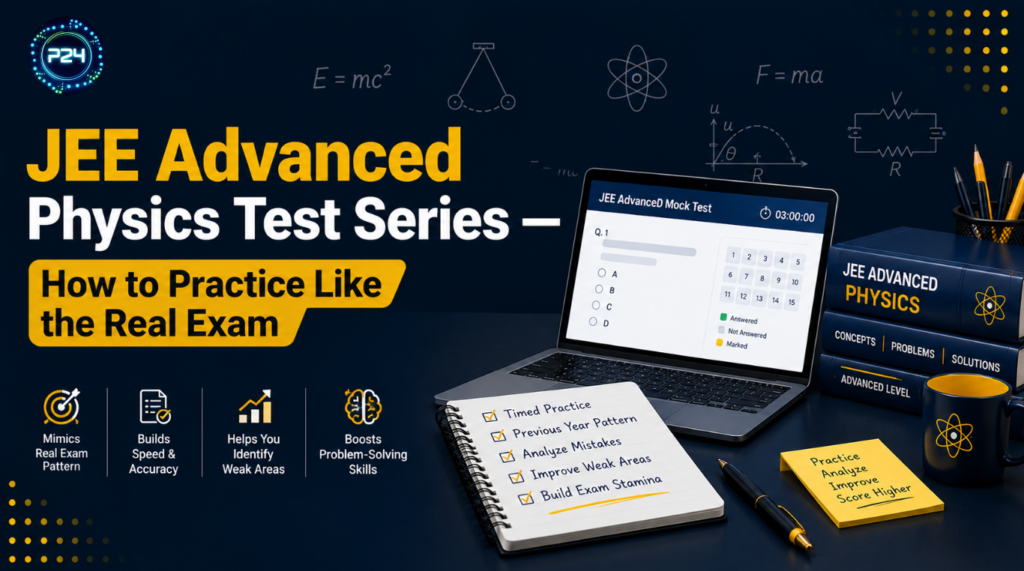
Checklist: What a Good JEE Advanced Physics Test Series Should Include
Before committing time to any test series, confirm it covers these five points:
- All four JEE Advanced question formats, in the correct ratio
- Strict, non-pausable timing that mirrors the real exam
- A mix of full-syllabus, cross-chapter tests — not only chapter-wise papers
- Mistake-type breakdown after each test, not just a percentage score
- A meaningful share of genuine PYQs within the test mix
A series missing the last two points can still give you practice, but it won’t give you the diagnostic clarity that actually raises your rank.
How Physics24 Applies This in Practice
Everything above is easy to agree with and hard to actually implement consistently — which is where most self-study test series plans break down. Here’s how Physics24‘s test series is structured around these exact principles:
1. Format-matched tests, physics-only: Every test follows the real JEE Advanced format — single correct, multiple correct, numerical value, and paragraph-based questions — in the same proportion as the actual paper. Because the test series is physics-only (not bundled with chemistry and mathematics), there’s no diluted 25-question chunk; a full test is a full physics paper.
2. Strict, real-exam timing: Tests run on a fixed weekly schedule under real exam conditions, so students build the same alertness and pacing they’ll need on exam day — not a relaxed, self-paced version of practice.
3. One-to-one mistake review, not an auto-generated report: After every test, a mentor goes through the student’s actual paper with them and sorts each wrong answer into the concept-gap / calculation-error / time-pressure / silly-mistake categories described above. Instead of a percentage score, the student leaves with a specific, named reason for each mistake and a plan to fix it.
4. Two-week re-testing on weak chapters: If a pattern shows up in a chapter, that chapter gets a focused re-test roughly two weeks later to confirm the fix actually worked rather than assuming one round of practice solved it.
5. PYQs built into the test mix: Genuine JEE Advanced PYQs from the last decade are blended into the full-length tests at the same 20–30% ratio recommended above, so students experience real exam-calibrated questions rather than only freshly-written ones.
The result is a test series designed less around “how many tests you get” and more around “how clearly you understand your own mistakes,” which is ultimately what moves a physics score in JEE Advanced.
How to Join Physics24 JEE Advanced Physics Test Series
- Visit physics24.in
- Book a free demo class with Pramod sir
- Discuss your current syllabus coverage and testing plan
- Enrol and begin integrated chapter-wise JEE Physics preparation
Reach out directly:
- +91 7711995520
- pramod.iitkgp07@gmail.com
- Physics24 App on Google Play
- Physics24 blog
How many JEE Advanced physics tests should I take per week?
One full-length test per week is generally enough in the final three months, provided you spend equal time reviewing and analyzing mistakes rather than just taking more tests.
Should I take chapter-wise or full-syllabus tests closer to the exam?
Full-syllabus, mixed-concept tests should dominate your practice in the last three months, since that’s the format JEE Advanced actually uses.
Are PYQs enough, or do I need a separate test series?
PYQs alone aren’t enough they should be blended into full-length mock tests (around 20–30%) rather than practiced in isolation, so you experience them under real exam conditions.
What's the biggest mistake students make with test series?
Focusing only on the score and moving to the next test, instead of categorizing and tracking the type of mistake behind every wrong answer.