
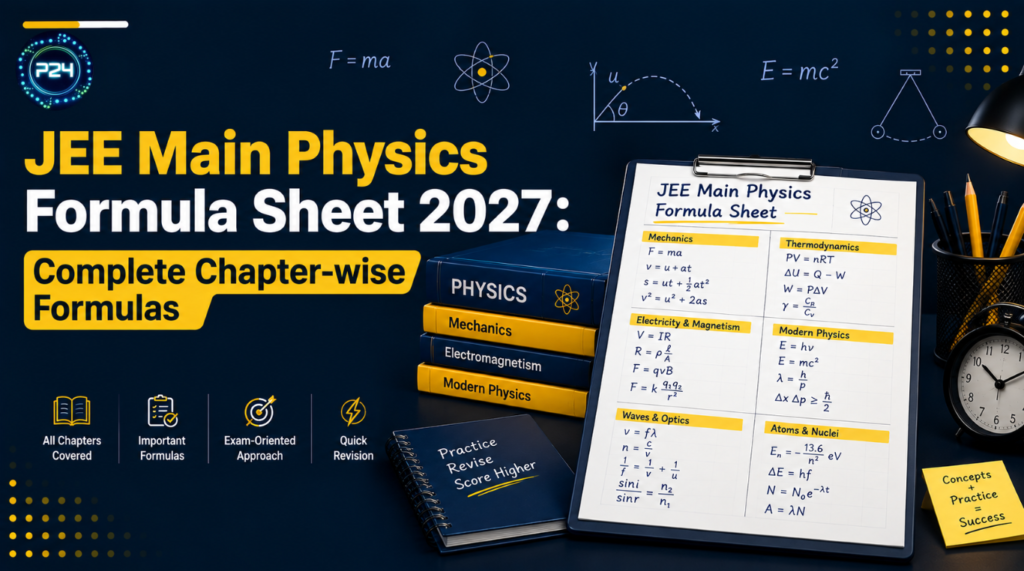
A JEE Main Physics formula sheet works only when it stays short and correct. Too long, and it becomes a second textbook. Too thin, and gaps show up mid-exam. This page gives chapter-wise formulas for 2027, plus a method to lock them in.
No formula sheet is provided in the exam, so every equation must be recalled from memory. One prep platform estimates that 60 to 70 percent of physics questions are directly formula-based. That is a lot of recall.
Why a Formula Sheet Never Replaces Concepts
A formula sheet is not a study plan. It shows what to write, not when to write it. Take a rotation problem. Solid sphere or hollow shell? The wrong moment of inertia ruins the whole answer.
Recall fails when the concept is missing. So use the sheet after learning a chapter, never instead of it. Sounds obvious? Most students still skip the first step.
2027 Syllabus Update: Check Before You Memorize
Skip formulas from deleted chapters. Communication Systems and Experimental Skills were removed in the recent syllabus reduction. Reports differ on the rest. One source lists Capacitors and Capacitance as dropped. Another says Semiconductor Electronics was only trimmed to basic diodes and transistors.
The official answer comes with the NTA bulletin. That document is expected in October or November 2026. Until then, treat this sheet as a base. Tick each chapter against the official list once it lands. Session 1 runs January 22 to 30, 2027. Time is short.
Chapter-wise JEE Main Physics Formula Sheet
Start with the heavy chapters. Modern physics, electrodynamics, thermodynamics, and mechanics carry a large share of formula-heavy questions. Mechanics alone is reported to supply 25 to 30 percent of physics questions. So the table opens there.
Not every row deserves equal time. Modern Physics, Electrostatics, and Current Electricity are formula-heavy and high in weightage. Give them two revision slots a week. Give lighter chapters one.
| Chapter | Key formulas |
| Kinematics | v = u + at; s = ut + ½at²; v² = u² + 2as. Projectile: R = u² sin2θ / g, H = u² sin²θ / 2g, T = 2u sinθ / g |
| Laws of Motion | F = ma; f(max) = μN. Incline: a = g(sinθ – μ cosθ). Banking without friction: v² = rg tanθ |
| Work, Energy, Power | W = Fs cosθ; KE = ½mv²; spring PE = ½kx²; P = F·v. Perfectly inelastic: v = (m₁u₁ + m₂u₂)/(m₁ + m₂) |
| Rotational Motion | τ = Iα; L = Iω; KE = ½Iω². Ring: I = MR². Disc: I = ½MR². Solid sphere: I = 2MR²/5. I = I(cm) + Md² |
| Gravitation | F = Gm₁m₂/r²; g = GM/R²; v(escape) = √(2gR); v(orbit) = √(GM/r); U = -GMm/r |
| Thermodynamics and KTG | ΔU = Q – W; PV = nRT; v(rms) = √(3RT/M); Carnot η = 1 – T₂/T₁; adiabatic PV^γ = constant |
| SHM and Waves | T = 2π√(m/k); pendulum T = 2π√(L/g); v = ω√(A² – x²); v = fλ; string v = √(T/μ) |
| Electrostatics | F = kq₁q₂/r²; E = kq/r²; V = kq/r; C = ε₀A/d; U = ½CV²; Gauss: φ = q/ε₀ |
| Current Electricity | V = IR; R = ρl/A; P = VI = I²R; I = nAe·v(d); Wheatstone balance: P/Q = R/S |
| Magnetism | F = qvB sinθ; r = mv/qB; wire B = μ₀I/2πr; loop center B = μ₀I/2R; solenoid B = μ₀nI |
| EMI and AC | ε = -dΦ/dt; ε = Blv; U = ½LI²; Z = √(R² + (X(L) – X(C))²); resonance ω = 1/√(LC); V(rms) = V₀/√2 |
| Optics | Mirror: 1/v + 1/u = 1/f. Lens: 1/v – 1/u = 1/f. n₁ sinθ₁ = n₂ sinθ₂; sinC = 1/n; YDSE β = λD/d |
| Modern Physics | E = hf; KE(max) = hf – φ; λ = h/p; Eₙ = -13.6Z²/n² eV; N = N₀e^(-λt); T½ = 0.693/λ |
Use the g value each question gives. Never assume.
How to Use This JEE Main Physics Formula Sheet
Write the sheet from memory every Sunday. Re-reading feels productive, but it is passive. Writing exposes the gaps. One prep site suggests revising formulas once a week alongside daily practice.
Here is the decision moment. You cover a chapter row and write it out. Three formulas come easily. Two do not. Those two are next week’s targets. Nothing else matters as much.
A simple loop keeps this honest:
- Cover the table and write one chapter row from memory
- Mark each miss as forgotten, mixed up, or wrong condition
- Solve five PYQs using only those formulas
- Write units in every step
- Repeat missed rows before each mock
Reading is not practice. Writing is.
Mistakes That Waste a Formula Sheet
Most students memorize formulas without their conditions. That is the trap.
The equation v² = u² + 2as needs constant acceleration. Use it on a swinging pendulum and marks vanish. Mirror and lens formulas look alike, but one sign differs. Mirrors use 1/v + 1/u. Lenses use 1/v – 1/u. One slip flips the answer.
Modern physics adds unit traps. Mix eV and joules and the result is off by a factor of 10¹⁹. Five numerical questions per subject are compulsory in JEE Main. They give no answer options to warn you. Check units before you write the final number.
Get the JEE Main Physics Formula Sheet PDF
Physics24 pairs formulas with chapter tests and personal analysis. Pramod Niranjan sir holds a B.Tech from IIT Kharagpur and cleared IIT JEE 2007 with AIR 2849. He has taught JEE aspirants for 14 years, including at Resonance and Allen. Batches cap at two students, so every wrong answer gets a personal look.
Explore the
Class 11 Foundation Batch
Class 12 Target Batch
JEE Dropper Batch
1 to 1 Mentorship Program.
Watch free lessons on the Physics24 YouTube channel. Then book a free demo class.
Is a JEE Main Physics formula sheet enough to score well?
No. It supports recall only. Pair it with concept study, chapter tests, and previous year questions.
Which chapters need the most formula practice?
Mechanics, Electrostatics, Current Electricity, and Modern Physics. Each is formula-heavy and appears often.
When should I start using the sheet?
Right after finishing each chapter. Then revise weekly and before every mock.
Are deleted chapters still in the 2027 syllabus?
Communication Systems is out. Check the official NTA syllabus for the rest.