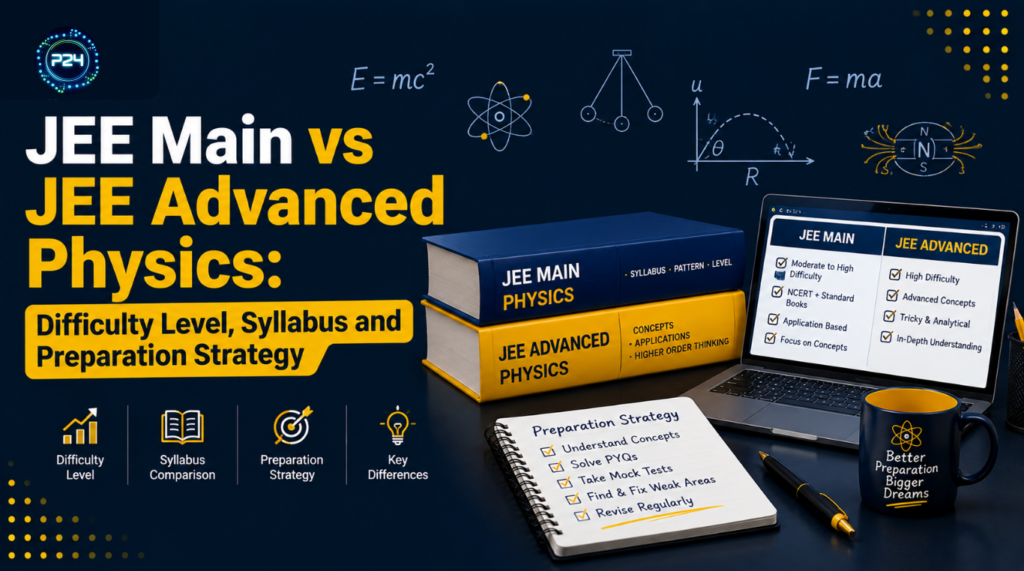
JEE Main vs JEE Advanced Physics is a contest between two different skills. Main rewards speed on familiar patterns. Advanced rewards thinking on patterns you have never seen. The syllabus core is shared. The exams are not.
Does the gap really matter? Ask anyone who sat JEE Advanced 2026. Experts in Kota said the physics paper would be the main factor in rank allocation. This guide compares pattern, syllabus, and difficulty. Then it lays out a plan for the 2027 cycle.
Exam Pattern: JEE Main vs JEE Advanced Physics Side by Side
The two papers do not even feel alike on screen. JEE Main Paper 1 has 75 questions across physics, chemistry, and math. Physics gets 25 of them, split into 20 MCQs and 5 numerical-value questions, and all five numericals are compulsory. Nobody picks five from ten anymore. That freedom is gone.
JEE Advanced plays by different rules. Two papers run on the same day, and candidates must appear in both. In 2026, Paper 1 had 48 questions and Paper 2 had 54, across all three subjects. Formats mix, and marking shifts by section. Read every header twice.
Penalties need care too. Wrong MCQ answers lose marks in Main. Sources disagree on the numerical section. Check the official NTA information bulletin before building a guessing plan.
Picture the last four minutes of a Main mock. Two numericals are blank. Do you guess or recheck one? That call needs a rule made in advance, not on the day.
Syllabus Overlap and the Topics That Differ
Both exams draw from Class 11 and 12 physics. Main covers a wide field, while Advanced goes far deeper into each topic. Chapter names match. Question depth does not.
Advanced tests thermal physics at a higher level, and Main includes Electronic Devices, which Advanced leaves out. Skip Electronic Devices for Advanced prep. Never skip it for Main. It is a short chapter with real marks.
Depth is the bigger gap. Advanced questions are layered and often mix several concepts in one problem. A Main question on rotation checks one idea. An Advanced question chains three. NTA is expected to publish the final 2027 information bulletin in October or November. Verify chapter lists there.
Difficulty Level: Where JEE Advanced Physics Pulls Away
Many students treat Advanced as Main with harder numbers. That view fails on exam day.
Main follows a short chain: concept, formula, answer. Advanced adds logic, application, and analysis before the answer shows up. Picture a block on a wedge. In Main, one law does the job. In Advanced, the wedge also slides, and friction acts on one face only. Three ideas now fight for the same ten minutes. Freeze there and the paper slips away.
Look at 2026 for proof. Physics was the toughest section in Paper 2, thanks to long conceptual problems. Electrodynamics and mechanics dominated, and modern physics supplied many quality questions. Experts even estimated General category qualifying marks near 30 to 33 percent.
Sounds low? It is. Advanced physics is built to leave most of the paper unsolved, even for strong students. Your job is to solve the right half.
Preparation Strategy for JEE Main vs JEE Advanced Physics
One plan can cover both exams. Order matters.
Build depth first. Speed sits on top of depth, never under it. Start each chapter with theory from HC Verma, then move to problem sets. Take a timed chapter test the same week. Skip that test and gaps hide for months.
Wrong answers need sorting, not just checking. A concept error needs theory. An application error needs more problems of that type. A careless error needs slower reading. Mixing the three up wastes weeks.
Habits that work:
- Test each chapter within a week of finishing it
- Label every wrong answer as concept, application, or careless
- Solve a few multi-concept Advanced problems every week
- Practice the 20 plus 5 split in every Main mock
- Start full mocks after 70 to 80 percent of the syllabus
Which chapters come first? Electrostatics, current electricity, and electrodynamics have dominated recent Advanced papers. Mechanics carries heavy weight in both exams. Start there.
2027 Timeline: Count Backward From January
January is closer than it looks. Full stop.
JEE Main 2027 Session 1 is scheduled for January 22, 23, 24, 28, 29, and 30. Session 2 is expected in April. JEE Advanced is expected in mid-May 2027, with IIT Delhi likely to organize it. No official date exists yet, so watch jeeadv.ac.in for the notice.
Eligibility has limits. Only the top 2.5 lakh JEE Main qualifiers can register. Each candidate gets a maximum of two attempts in two consecutive years. Work backward from January. Chapter tests first, mocks last.
Which Exam Should Shape Your Physics Prep?
Here is a blunt take. Prepare for Advanced depth, even when Main is the near goal.
Depth makes Main feel fast. Students who drill only Main patterns freeze when a question twists. Sounds extreme? It costs less than a dropper year.
Physics24 builds this two-layer plan into personal coaching. Pramod Niranjan sir holds a B.Tech from IIT Kharagpur and cleared IIT JEE 2007 with AIR 2849. He has mentored JEE aspirants for over 14 years and taught at Resonance and Allen. Batches cap at two students. Every test gets personal analysis, and the next week’s plan shifts to match.
Explore the Class 12 Target Batch, the JEE Dropper Batch, or the 1 to 1 Mentorship Program. Ready to start? Book a free demo class and share your current syllabus coverage.
Is JEE Advanced physics harder than JEE Main physics?
Yes. Advanced questions layer several concepts into one problem, while Main questions are usually direct and time-bound.
Do both exams share the same physics syllabus?
Mostly. Advanced goes deeper and adds thermal physics depth. Main includes Electronic Devices. Confirm final lists in the official bulletins.
Can one plan cover both exams?
Yes. Build depth first. Then add timed practice for Main speed.
When is JEE Main 2027 Session 1?
It runs across six dates from January 22 to January 30, 2027.