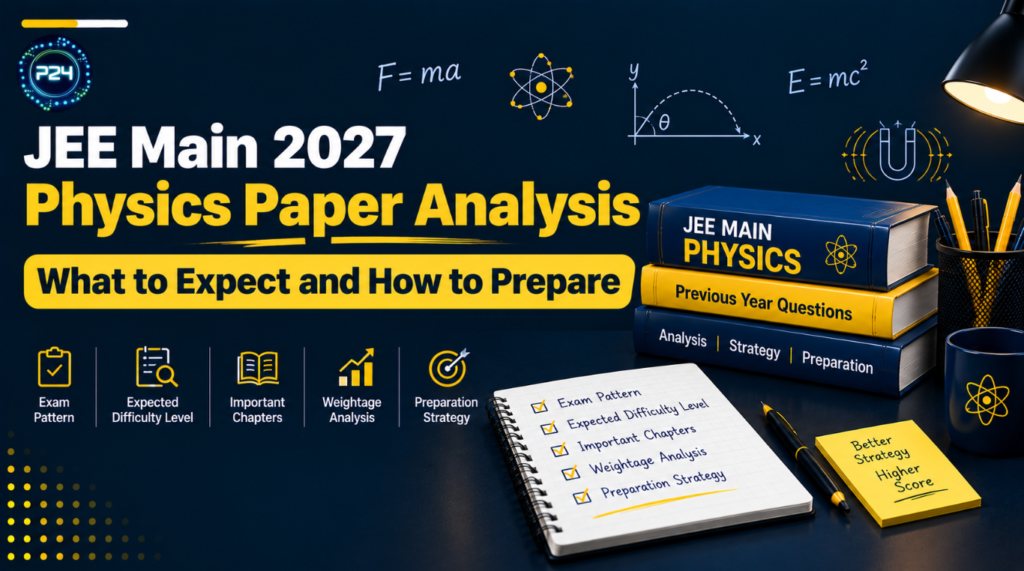
No JEE Main 2027 Physics paper exists yet. Session 1 is months away. So a true “2027 paper analysis” is not a review. It is a forecast, built on the pattern that 2026’s ten shifts have already laid out.
That pattern is not random. Difficulty repeats. Topics repeat. This analysis works backward from real 2026 data to a realistic picture of what the 2027 paper will look like.
Why a 2027 Analysis Must Start With 2026 Data
Predicting a paper with no data is guessing. Predicting it from the last full cycle is analysis.
Across JEE Main 2026, physics difficulty stayed remarkably consistent. Session 1 shifts were mostly rated moderate, with January 22 morning called tough and time-consuming while the evening shift felt easier. Session 2 followed the same rhythm: physics was moderate but calculative in most April shifts, occasionally dipping to easy-to-moderate.
That consistency is the real signal. NTA is not swinging difficulty wildly shift to shift. It is holding a narrow moderate band, with length and calculation load doing the work that raw difficulty used to do.
JEE Main 2027 Physics Paper Analysis: Difficulty Forecast
Expect moderate, not easy and not brutal. That has been the story for two straight sessions now.
The clearest 2026 pattern was this: physics was frequently the easiest of the three subjects, while maths ran long and chemistry stayed scoring. One April shift review called physics moderate but calculative, needing careful time management despite manageable difficulty.
Read that carefully. Moderate does not mean fast. Numerical-heavy, multi-step questions dressed as moderate difficulty have been the actual trap across 2026. Expect the same in 2027. Prepare for calculation speed, not just concept recall.
High-Weightage Topics Likely to Repeat
Some chapters are not optional bets. They show up shift after shift, year after year.
Based on 2026 session data, these topics carried the load:
| Topic | 2026 signal |
| Modern Physics | Consistently high weightage, appeared in nearly every shift analysis |
| Current Electricity | Frequently paired with Electrostatics across both sessions |
| Electrostatics | High-frequency topic in Session 1 and Session 2 |
| Heat and Thermodynamics | Recurring 3 to 4 question presence per shift |
| Rotational Motion and Optics | Regular appearance, especially in Class 12-heavy shifts |
| Magnetism and Semiconductors | Steady medium-weightage presence |
Modern Physics alone accounted for roughly 18 percent of physics marks in multiple 2026 shift breakdowns. That is not a chapter to leave for the last week.
Class 11 vs Class 12 Split: What 2026 Showed
One detail matters more than most students realize. Physics was described as manageable with most questions from Class 11 in at least one January 2026 shift, while other shifts leaned Class 12 heavy with optics, rotational motion, and modern physics.
The split shifts within a single session. That means a 2027 candidate cannot assume either half of the syllabus is safe to under-prepare. Build both halves at equal depth, and let weightage data only decide revision order, not coverage.
What “Real Exam Pattern” Means for 2027
The structural pattern has held steady for several sessions and is expected to carry into 2027 unless NTA issues a change in the official bulletin.
Physics carries 25 questions: 20 MCQs with negative marking, and 5 numerical-value questions. Build every 2027 mock around that exact split, not a generic 25-MCQ paper.
Session timing has been more predictable than difficulty. JEE Main 2027 Session 1 is expected across six dates from January 22 to 30. Confirm the final dates and any pattern change on the official NTA website once the information bulletin is released.
How to Prepare Using This Forecast
A forecast is only useful if it changes what gets studied first. Here is the order that follows from the 2026 data above.
- Lock Modern Physics, Current Electricity, and Electrostatics first. These carried weight in nearly every 2026 shift.
- Treat both Class 11 and Class 12 chapters as exam-ready. The heavy half shifted shift to shift in 2026.
- Practice speed under the 20 plus 5 format specifically, since calculative-but-moderate was the repeated 2026 description, not raw difficulty.
- Time every chapter test strictly. Length, not concept difficulty, is what has been costing marks.
- Revisit weak chapters through mixed section tests, not isolated chapter revision, since shifts mix topics unpredictably.
Analysis without testing is just information. Convert this forecast into timed chapter tests, then section tests, then full mocks, in that order.
How Physics24 Uses Real Paper Data in Coaching
Physics24 does not prepare students against a guess. Every chapter test and mock is built around the actual topic and difficulty trends from recent JEE Main sessions, then adjusted personally as new session data comes in.
Pramod Niranjan sir holds a B.Tech from IIT Kharagpur and cleared IIT JEE 2007 with AIR 2849. He has mentored JEE aspirants for over 14 years, including at Resonance and Allen. Batches cap at two students, so preparation is adjusted to each student’s actual weak topics, not a generic weightage table.
Explore the Class 12 Target Batch, the JEE Dropper Batch, or the 1 to 1 Mentorship Program. Watch free lessons on the Physics24 YouTube channel. Then book a free demo class.
Is there an official JEE Main 2027 Physics paper analysis yet?
No. The exam has not been conducted. This analysis is a forecast built on 2026 session data and trends.
Will JEE Main 2027 Physics be easier or harder than 2026?
Based on the last two sessions, expect a similar moderate, calculation-heavy pattern rather than a major difficulty shift.
Which physics topics should I prioritize for 2027?
Modern Physics, Current Electricity, Electrostatics, and Heat and Thermodynamics showed the most consistent weightage through 2026.
Does JEE Main Physics test Class 11 or Class 12 more?
It varies by shift. Some 2026 shifts leaned Class 11 heavy, others Class 12 heavy. Prepare both at equal depth.